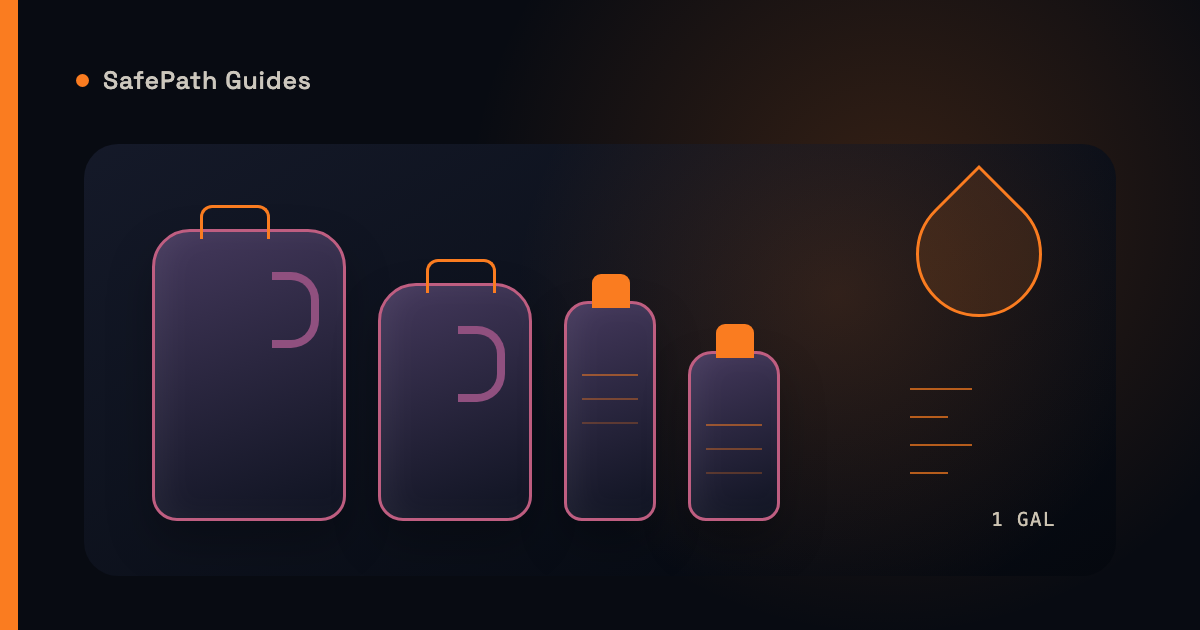
Water is the least interesting item in an emergency kit and the first one that matters. Every federal checklist puts it on line one, yet "store water" hides three real questions: how much, in what, and for how long before it needs replacing. The answers are more specific than most kits account for — and they scale with your family, your climate, and your pets. Here is what Ready.gov and the CDC actually recommend, and the honest math for a real household.
The short answer: a gallon per person per day — then aim higher
Both federal authorities start from the same baseline: one gallon of water per person per day, covering drinking and sanitation together. Ready.gov's current guidance says to store at least that much for "several days," and notes a normally active person needs about three quarters of it just for drinking. The CDC's water-supply guidance frames it as a three-day minimum — and then asks families to aim for a two-week supply at home when they can. The arithmetic is the sobering part: for a family of four, three days is 12 gallons; two weeks is 56. You do not need to reach the full number this weekend — you need to know which number you are working toward.
Who needs more than the baseline
The gallon-per-person figure assumes an average person in a temperate climate — several categories of household member move the number up. Ready.gov names children, nursing mothers, and sick people as needing more, and adds that in very hot temperatures, water needs can double. The CDC adds pregnant women and hot-climate households to the more-than-baseline list — and pets, which get their own section below. If your August involves triple digits, plan for the doubled figure, not the baseline.
Bottled first: the simplest correct answer
The CDC calls unopened, commercially bottled water the safest and most reliable emergency supply — for drinking, cooking, and brushing teeth. The maintenance rules are refreshingly short: observe the expiration date, and keep it sealed in its original container until needed. For most families, cases of bottled water in a closet are the entire strategy — cheap, rotated through normal use, and impossible to get wrong.
Storing your own: containers, labels, and the six-month rule
Filling your own containers costs less per gallon but adds rules that matter. Per the CDC: use FDA-approved food-grade water storage containers — the kind that will not leach into the contents — and sanitize them before filling. Never reuse a container that previously held toxic substances such as bleach or pesticides. Label each one "drinking water" with the date, and replace self-filled water every six months — Ready.gov states the same interval. Store everything somewhere cool (the CDC suggests 50–70°F), out of direct sunlight, and away from any stored chemicals.
Pets drink too
A family supply that ends at the humans is incomplete. Ready.gov's pet-preparedness guidance puts several days of water for each pet — plus a bowl — in the pet's own emergency kit, alongside food and medications. A large dog in a hot climate is not a rounding error; add it to the math from the top of this article.
If the stored water runs out
Storage is the plan; treatment is the fallback. If safe bottled water is not available, the CDC's emergency water guidance identifies boiling as the best way to kill germs in water — Ready.gov uses nearly the same words, calling boiling the safest method of treating water. The details depend on your situation and water source, so read the CDC's full guidance before you need it, and follow instructions from local officials about water safety during an actual emergency — they know what is in your system.
Where SafePathApp fits
Water is the clearest example of preparedness as maintenance: a number to hit, a date to rotate, a place to store. SafePathApp was built for exactly that kind of upkeep — its preparedness checklists and go-bag guidance are tailored to the hazards likely in your area, so the water line sits next to everything else your family needs packed, and the app remembers the state of your kit so you don't have to. If this is your first stop, our full family checklist and go-bag guide cover the rest of the kit — and this month's Prepared This Month turns it into a 15-minute habit.
Sources
Continue Reading
Emergency Planning With Kids and Pets: A Family Preparedness Guide
Plans fail at the soft parts — the kid at school, the cat under the bed, the phone number nobody memorized. How to plan for the family you actually have.
SafePathAppUnderstanding AQI and Wildfire Smoke: When Should You Stay Indoors?
The colors on the air quality map, decoded — what PM2.5 does, who needs to be careful sooner, and the official playbook for smoke days.
SafePathAppWildfire Preparedness for Families: What to Do Before an Evacuation
Evacuations are won before they start — Ready, Set, Go!, the difference between a warning and an order, and the decisions to make while the sky is still blue.
SafePathApp