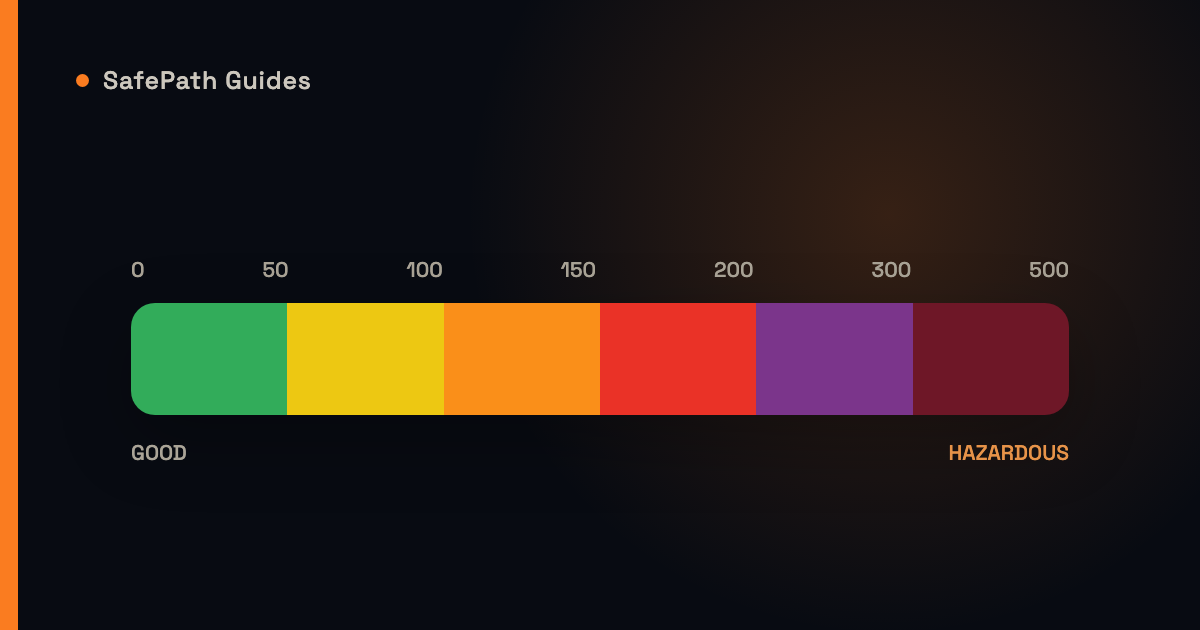
Smoke days come with a number, and most of us were never taught to read it. The Air Quality Index is genuinely simple once decoded — six colors, one pollutant that matters most during fires, and a short list of official actions for each level. One thing before we start: this guide summarizes public-health agency guidance, not medical advice. If anyone in your family has a heart or lung condition, is pregnant, or has symptoms that concern you, your healthcare professional's guidance comes first.
What the AQI actually measures
The AQI runs from 0 to 500 across six color-coded categories, per AirNow: Good (green, 0–50), Moderate (yellow, 51–100), Unhealthy for Sensitive Groups (orange, 101–150), Unhealthy (red, 151–200), Very Unhealthy (purple, 201–300), and Hazardous (maroon, 301+). The number is an index, not a raw measurement — a translation of pollutant concentrations into one everyone-can-read scale. During wildfire season, the pollutant driving that number is almost always fine particulate matter.
Why PM2.5 is the one to watch in smoke
PM2.5 means particles 2.5 micrometers and smaller — small enough to reach deep into the lungs, with some entering the bloodstream, which is why the EPA identifies fine particles as the pollutant of greatest health concern. In wildfire smoke specifically, the EPA calls PM2.5 the principal public-health threat. That is the mechanism behind the color scale: the smaller the particle, the further it travels into you.
Who needs to be careful sooner
The orange category is named for a reason. Per the EPA, the groups at higher risk from smoke include children — whose lungs are still developing and who breathe more air per pound of body weight — older adults, pregnant people, people with heart or lung disease, and outdoor workers whose exposure is simply longer. For these groups, precautions start at lower AQI values than for everyone else. 'Sensitive groups' is most families: if your household includes a child or a grandparent, orange is your yellow.
The official playbook for a smoke day
When agencies advise staying indoors, the EPA's guidance is specific about making indoors count: keep windows and doors closed, run a portable HEPA air cleaner or upgrade your HVAC filter, and avoid adding particles inside — no smoking or vaping, no candles or incense, no frying or broiling, no vacuuming without a HEPA filter, and no gas, propane, or wood-burning appliances if you can help it. A closed house with a candle burning is not a clean room.
If you must go out: the mask that works
The CDC's guidance for smoke events is unambiguous about masks: a NIOSH-approved N95 respirator, fitted properly, is what protects against smoke particles — dust masks, surgical masks, bandanas, and wet cloths do not. This is where the go-bag N95s from our wildfire preparedness guide earn their slot.
Watch the number, not the window
Smoke shifts with the wind, and the view outside lags the measurement. The CDC points people to AirNow.gov for current local AQI and to AirNow's Fire and Smoke Map when fires are active. Conditions can swing between categories in hours, so the habit that matters is checking before outdoor plans — practice, recess, the dog's long walk — rather than once a day.
If someone in the family has a condition
The CDC advises people with chronic heart or lung conditions to talk with their healthcare provider before smoke season, follow their provider's plan — including any asthma action plan — during smoke events, and contact the provider if symptoms like trouble breathing or a persistent cough do not settle. Nothing in this article overrides that relationship; the AQI tells you about the air, not about your body.
Where SafePathApp fits
The gap on smoke days is friction: the number lives on one site, the fire on another, your family's plan on paper. SafePathApp puts current air quality with plain-language guidance next to the live hazard map, so 'should the kids play outside?' is one glance, not a research project — with alerts when conditions near you change. For medical decisions, your clinician and public-health agencies always come first.
Sources
Continue Reading
Emergency Planning With Kids and Pets: A Family Preparedness Guide
Plans fail at the soft parts — the kid at school, the cat under the bed, the phone number nobody memorized. How to plan for the family you actually have.
SafePathAppHow Much Emergency Water Should a Family Store?
One gallon per person per day is the start, not the answer — how much your family actually needs, safe storage, and the six-month rule.
SafePathAppWildfire Preparedness for Families: What to Do Before an Evacuation
Evacuations are won before they start — Ready, Set, Go!, the difference between a warning and an order, and the decisions to make while the sky is still blue.
SafePathApp